
When you look for Thai massage courses or treatments in Thailand, you may have encountered the phrase Lanna Thai massage. In this article, we’re going to explore what “Lanna” stands for, and what exactly is meant by Thai Lanna healing arts treatment modalities. We will also discuss the availability of training options.
The Lanna Kingdom
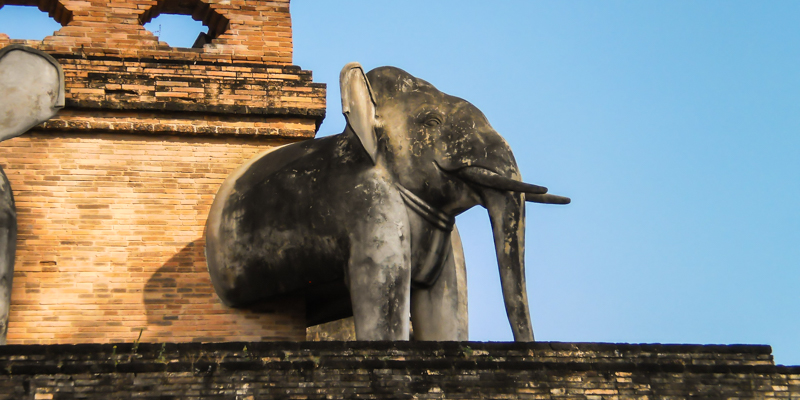
Let’s first look at the word Lanna. The Lan Na or Lanna Kingdom was a T’ai state (part of the T’ai peoples (Tai), later called Thai) heavily influenced by Indic culture, and located in Northern Thailand between the 13th and 18th century. It also covered some parts of current Laos, Myanmar, and China. The word “Lanna,” by the way, literally means “Million Rice Fields.”
Chiang Mai, the capital city of the Lanna Kingdom, was built in the year 1296. In the 16th century the Kingdom was conquered by the Burmese and it became a tributary region for Burma (now Myanmar). Later, in 1774, with help of Siam (today called Thailand) the Burmese were driven out, and in 1892 the Lanna Kingdom became a definite part of Siam. In 1932, the Chiang Mai area became a province of Siam. In 1949, what was called Siam, officially became known as Thailand.
Lanna Culture Today
Although the Lanna Kingdom suffered various invasions and annexations by foreign conquerors, the Lanna culture is still quite alive today. Nevertheless, Lanna culture was/is an eclectic ensemble of its own Tai background, Sri Lanka Theravada Buddhism, Lawa and Mon culture, animism, Hindu religions, the Burmese and Chinese culture, likewise influenced by its Thai neighbor — the Sukhothai Kingdom, and later Ayutthaya Kingdom (another subgroup of Tai people).
Today, the Lanna region is part of the Kingdom of Thailand, but the former Lanna cities, such as Chiang Mai, Chiang Rai, Lampang, Lamphun, and some others, are sought-after tourist destinations because of the beauty and splendor of the Lanna culture, architecture, and arts.
Lanna Folk Healing Arts
The Thai Lanna Healing Arts (or Thai Lanna Medicine) are well-known for its herbal tradition and heritage, as well as its healing through various forms of massage and bodywork.
 eBook
eBook
Thai Lanna healing arts are well known for their herbal tradition and heritage, as well as for their various specific forms of massage and bodywork.
In the local villages and towns in the region you’ll still find so-called mor meuang or local town doctors and folk healers. These traditional healers practice paet peun baan, which is a localized system of medicine that predates modern Western medicine and even the systematized Royal Thai Medicine.
The local medicine of the Lanna region is recorded in texts and teachings in the Lanna language and as said, still much alive and in continuous development, notably because of modern developments and influences, like the Thai massage and Thai medicine revival projects, but also because of direct influences through healing modalities from the West.
Parts of Lanna Medicine are now incorporated in what’s called Traditional Thai Medicine (TTM), and elements from TTM are now also integrated in Lanna Medicine.
Another common way to look at the Lanna Healing Arts is as being so-called Hill Tribe Medicine, where “Hill Tribe” is a common name for the many different ethnic and cultural groups in Northern Thailand, peoples coming originally from a broad range of regions and countries in Asia, such as Myanmar, Tibet, Nepal, Laos, and China. Hill Tribe Medicine is perhaps more than Lanna Medicine often still considered Thai Indigenous Medicine.
One of the important characteristics that distinguishes Lanna healing from mainstream TTM is that practitioners incorporate ancient animist beliefs into their work. In the Lanna context, this involves the idea that spirit (and spirits), mind, and energy reside in all things and form a holistic unity. In fact, traditional Lanna healing is practiced in a shamanic context. Spiritual ripeness of the practitioner plays an important role, and to become a Lanna healer requires being accepted by a master and undergoing a Wai Khru initiation.
eBook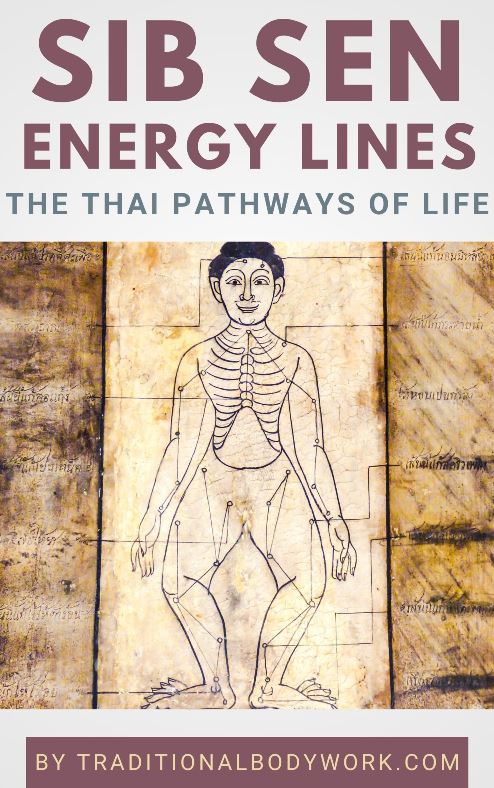
Some examples of Lanna spirits (a spirit in the Lanna region is known as Phi) are Phi Pu Ya (ancestral spirits that protect the family lineage), Phi Suea Ban and Phi Suea Wat (guardian spirits of the village/city and temple). In addition, you’ll find many types of Nature spirits, who need to be appeased to, for instance, ensure the fertility of the rice fields, the availability of water in rivers, and the timely arrival of the monsoon.
Traditional Lanna healing sessions, such as herbal treatments, bone setting, spiritual healing, or massage, are usually accompanied by spirit invocations, incantations, prayers, ceremonies, rituals, chants, and the like.
Another important characteristics of Lanna healing is that it’s not considered a job but rather a moral obligation, typically given for free or on the basis of a donation, the latter supporting Lanna folk healers materially and financially.
Lanna Folk Healing Treatments and Training Options
Traditional Lanna Thai Massage
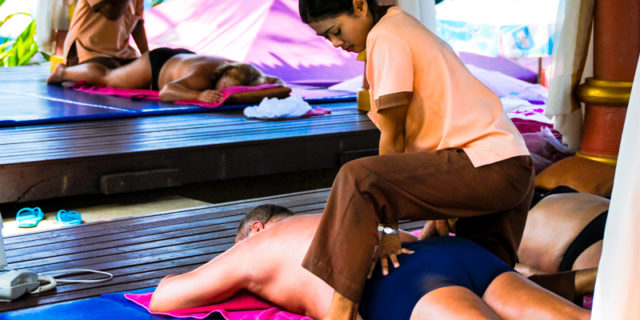
Lanna Thai massage differs somewhat from mainstream traditional Thai massage.
eBook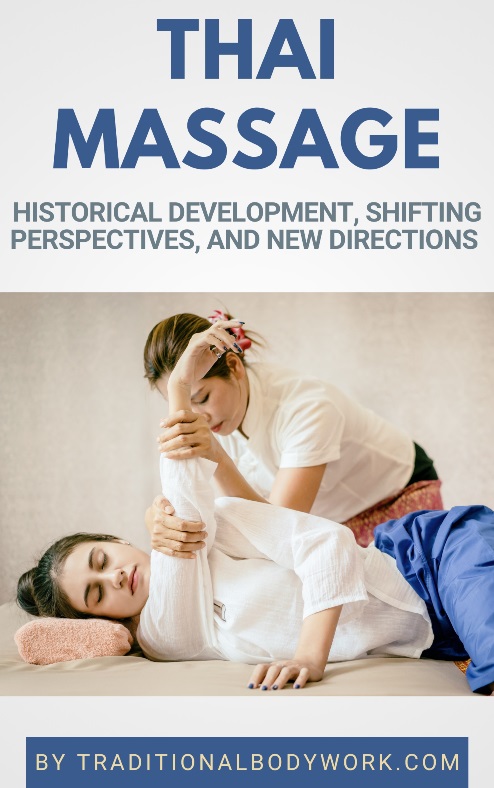
The main goal of Thai Lanna massage is to relieve tensions and stiffness (the latter perhaps to do with the mountainous area in the North), and seems to be softer and more gentile than southern style Thai massage.
Lanna massage is also applied for healing the internal organs like the stomach, the intestines, testicles, uterus, and prostate. Often herbs are also applied. We find obvious traces hereof in the more modern Chi Nei Tsang, Karsai Nei Tsang, and Nerve Touch massage modalities.
There’s basically no pattern or sequence of techniques as often seen in traditional Thai style massage, and it’s certainly not always a full body massage. Durations can be from around fifteen minutes to two hours, very much depending on the specific health issues of the receiver.
A small selection of Thai massage schools in Chiang Mai offer specific Thai Lanna massage training. In general, training of typical Thai Lanna healing modalities is seldom to be found outside the Chiang Mai region.
Tok Sen
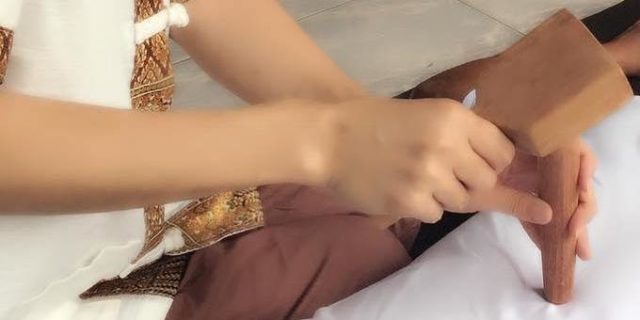
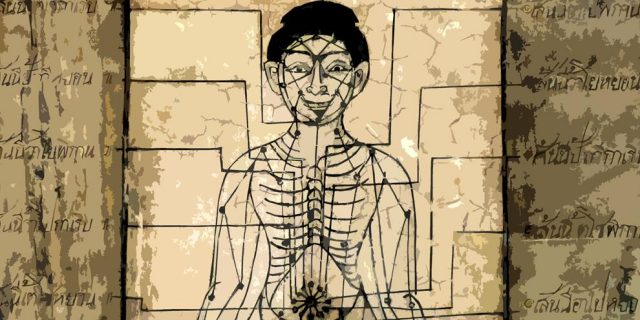
Thai Tok Sen is a typical Lanna Thai folk healing practice, and uses a a short-handled hammer and a wedge of wood, bone or ivory to tap along the Sib Sen energy lines of the body.
The tools can be made of various materials, because usage depends on the goal of a treatment and also on the Tok Sen teaching lineage. Often, certain spiritual rituals are performed while obtaining and making the tools.
Typically, the practitioner recites chants, incantations or invocations in order to promote healing of the patient and to protect the receiver and themselves against negative energies.
Most Tok Sen training courses can be found in the Chiang Mai region, although courses are also offered in other parts of Thailand, notably in Bangkok.
Thai Fire Therapy (Yam Khang)
Yam Khang, also called Thai fire therapy or Thai thermal massage Therapy, is a barefoot massage that uses heat, oils, and the feet to treat the body of the patient. The goal of the treatment is to help relieve the patient from muscle, tendon, joint and bone pains, but also from numbness and paralysis.
Yam Khang training courses are extremely rare and can only be found in Northern Thailand.
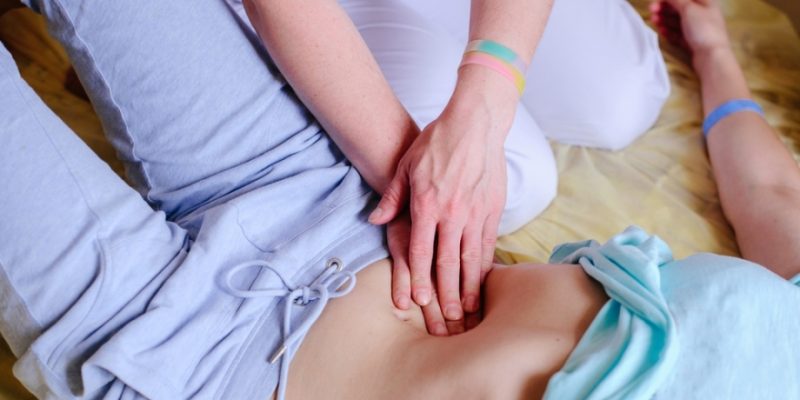
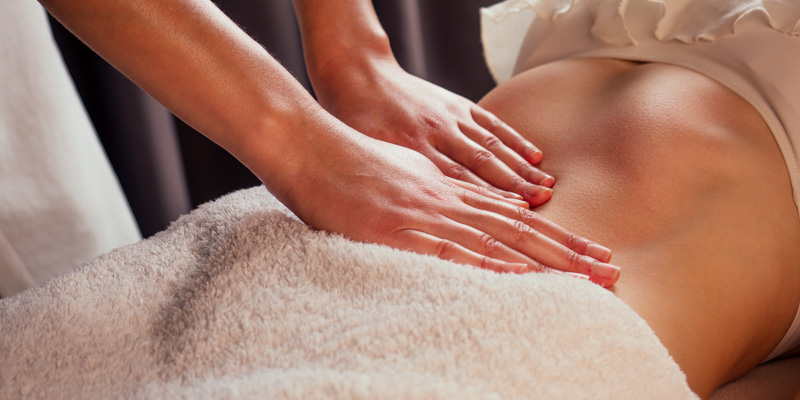
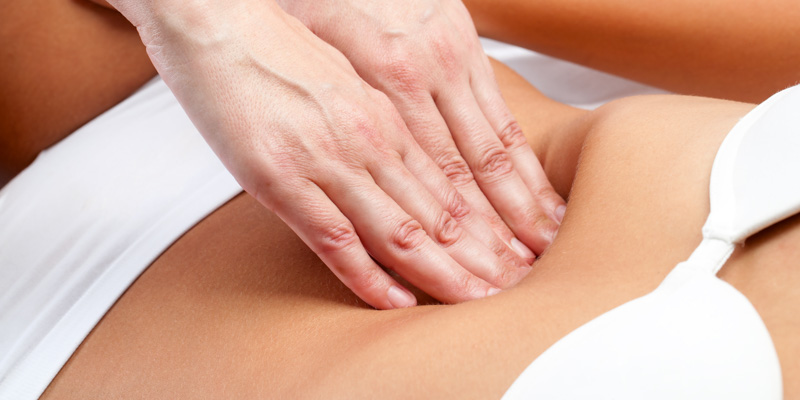
Thai Abdominal Chi Massage (Chi Nei Tsang)
Chi Nei Tsang is a hybrid of ancient Lanna abdominal massage, Thai abdominal massage, and Chinese influences, newly (re)developed by Mantak Chia (Tao Garden, Chiang Mai).
The goal is to recycle and transform negative energies that obstruct the abdominal area and internal organs, in order to restore the body’s energy flow, balance, and healthy functioning. Deep abdominal work is also thought to be beneficial in healing emotional and psychological issues.
Various training courses can be found in Chiang Mai, with a choice of Thai massage schools.
Thai Genital Detox Massage (Karsai Nei Tsang)
Karsai Nei Tsang is a specialization of Chi Nei Tsang, and a hybrid of ancient Lanna genital massage, Thai genital massage and Chinese influences, newly (re)developed by Mantak Chia (Tao Garden, Chiang Mai).
The purpose of the treatment is to heal and stimulate the genital system by removing blockages and toxins in the genital area. The modality strongly focuses on issues and difficulties with the sexual organs, urination, fertility, impotency, painful menstruation, or painful scar tissue after giving birth, low sexual libido and painful intercourse.
Various training courses can be found in Chiang Mai, with a choice of Thai massage schools.
Thai Womblifting
Womb Lifting involves hot sea salt crystals in a clay pot wrapped in medicinal leaves and applied as a compress pack. The process likewise manipulates acupressure points on the abdominal area, legs, buttocks and back.
The uterus (womb) is manipulated directly with the hands on the abdomen. The treatment serves post-natal health and relief for fertility problems, as well as overall health and well-being.
A few individual Thai massage teachers and therapists in Chiang Mai offer Thai Womblifting training courses.
Thai Uterus Massage
This kind of massage and treatments depends much on the lineage of the practitioner. In general one can trace influences, parallels and/or combinations of Thai Womb Lifting, Karsai Nei Tsang, Thai abdominal massage, and Yok Thong.
Only a few individual Thai massage teachers and therapists in Chiang Mai offer Thai uterus massage training courses.
Thai Lanna Detox (Ched Haek)
Ched Hak Thai massage is an ancient Lanna detox technique that uses claws of animals (that died naturally and without suffering) in the procedures during the treatment.
The instrument used, blessed and considered of power, is wiped on the receiver’s body, while the therapist gives prayers and chants of empowerment, purifying and cleaning the receiver, and bringing vitality and universal forces to the receiver.
Only a few individual Thai massage teachers and therapists in Chiang Mai offer Ched Hak courses.
Luk Pra Kob (Thai Herbal Compress Massage)
Technically not only a Lanna massage modality, but applied across Thailand (and Asia), but as the Thai Lanna Kingdom is renown for its herbal heritage you’ll find rich (therapeutic) applications of hot and cold herbal compresses and packs in Northern Thailand, not rarely combined with a full body massage.
This modality can be learned at most Thai massage schools in Thailand, although depth of teachings (what herbs to apply for what kind of therapy) varies considerably.
Thai Barefoot Massage (Walking Massage)
Video Workshop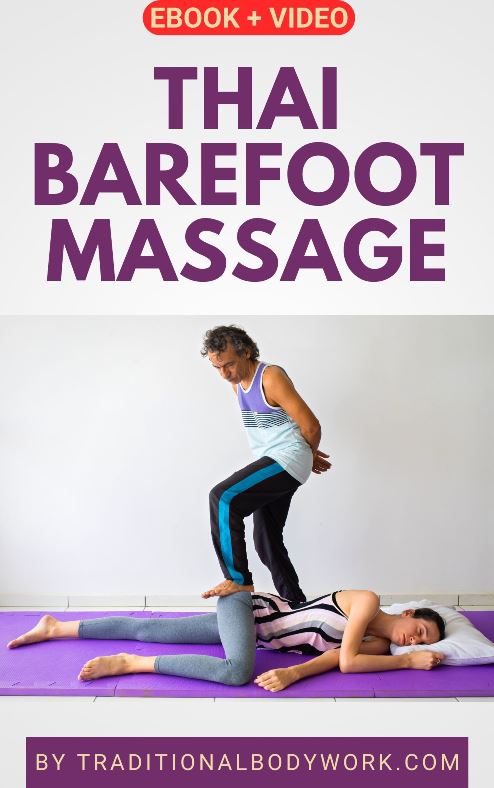
Specifically in the north of Thailand and among certain Hill Tribes, so-called “walking massage” or Thai barefoot massage is a rather popular form of Thai massage application.
Treatments given with the feet have a total other — more earthy and grounded — quality than when applied with the hands or other parts of the body. In general, more pressure can also be applied.
Sometimes the barefoot massage practitioners and therapists use a stick, rod, or rope to keep their balance while “walking” over the patient.
Specialized Thai barefoot massage training is relatively rare, yet (partial) training options can be found across Thailand.
Thai Amatarot Massage
Amata Rot is a relatively young Lanna therapy (about a 100 years old) that uses a wooden stick or rod with various appliances (depending on the application) sticked to the end of the rod, with which the patient is treated.
It’s used to give therapy, and penetrates deeply on tendons and fascia. It’s used for relieving or curing sciatica, postural imbalances, joints issues, physical pains, low energy, and tensions, among other conditions.
Thai Amatarot Massage training can only be found in Northern Thailand, and with just a handful of teachers.