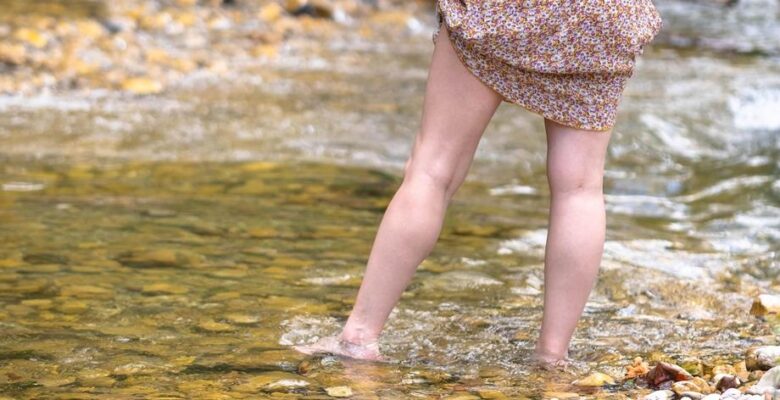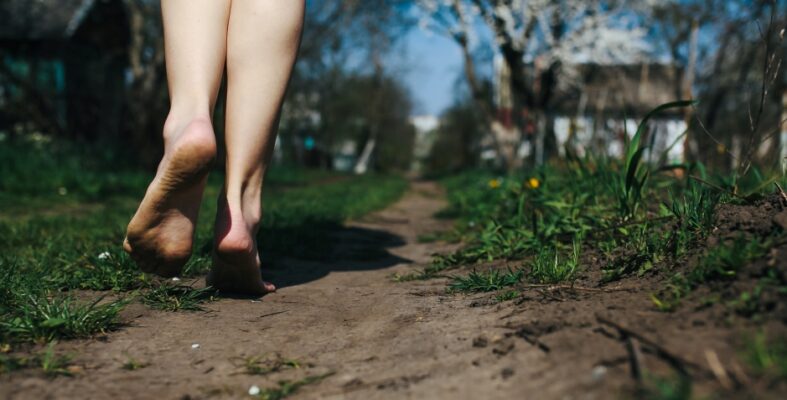

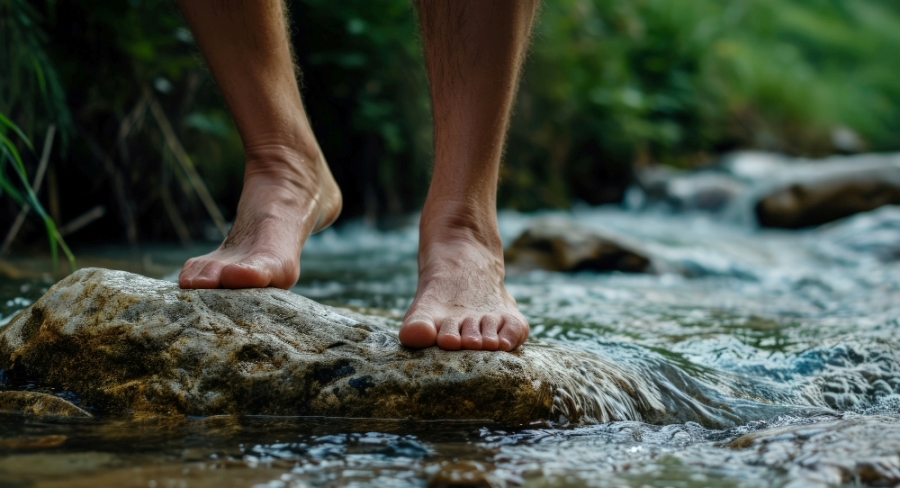
Barefoot hiking is about walking on nature trails, in the mountains, or in forests with bare feet or minimalist footwear.
Those who are in favor of the practice do so to allow their feet to move naturally, engage underutilized joints and muscles, and interact more closely and dynamically with the terrain and nature.
 eBook
In fact, especially traditional hiking boots act like a rigid cast. That is, they stabilize and protect the ankle but at the same time, they immobilize the network of bones, joints, and dozens of muscles in the feet. Over time, this reliance can weaken the feet’s natural arches and strength, while also cultivating less situational awareness.
Walking barefoot on trails also promotes a natural, low-impact stride, typically switching from a heavy heel-strike to a softer mid-foot landing. This can promote structural body alignment and likewise diminish stress on the knees, hips, and lower back.
Going barefoot also improves one’s grip on the terrain. For instance, spreading the toes wide lets you naturally grab onto rocks or adapt to uneven roots for stabilization and balance.
Research has also shown that the direct contact with natural surfaces like grass, soil, rock, wood, and sand shifts the nervous system into a relaxed state, lowering cortisol, and boosting overall mood.
However, although having significant physiological and mental benefits, barefoot hiking does require preparation, structural adaptation, and heightened situational awareness to prevent injury, notably if one isn’t accustomed to barefoot walking.
eBook
Therefore, it’s a good idea to first start with safe and softer trails (for instance, in a nearby park) that are clean, smooth, and devoid of hidden debris, sharp rocks, or snakes and the like, and hence don’t pose a great risk for infections or injury. Moreover, in some countries, you’ll find parks and trails that are specifically designed for barefoot hiking.
In a more general sense, it’s advised to spend a few weeks walking barefoot around your own house and garden to awaken inactive foot muscles.
In any case, if you go on barefoot hikes it’s always recommended to bring a small first-aid kit with you that contains plasters, tweezers, and disinfectant. You never know. It’s also good to have a pair of shoes with you as a backup. In fact, even if you’re a practiced barefoot hiker, you might encounter a stretch where it’s safer to wear shoes.