

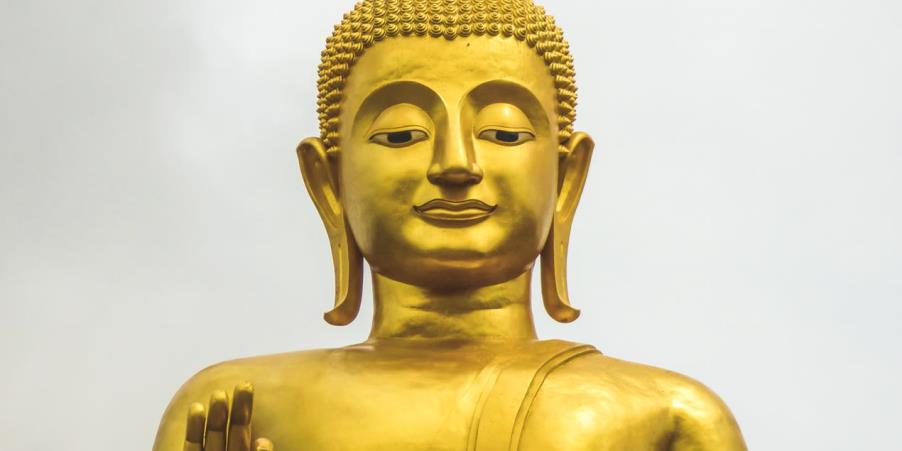
When you seriously study Thai Massage in Thailand — that is, not a two day backpacker’s training course — you’ll most likely quickly become acquainted with the Buddhist spiritual setting of the teachings.
 eBook
eBook
For instance, Thai massage instructors in Thailand will often pay their respects to Jivaka Komarabhacca (the Buddhist patron of Thai Medicine) and to their own teachers and lineage before starting the Thai massage classes of the day.
This daily ritual — typically a short Wai Khru ceremony — is usually accompanied by religious chants and prayers (often in both the Thai and Buddhist Pali language), burning incense, kneeling in front of an altar with little statues and pictures, meditation, and whatnot.
At first, this may feel a bit strange when studying Thai Massage, but gradually you’ll get used to the setting and intentions and maybe even start to value it or want to do it yourself.
Some Thai teachers in Thailand will also ask (or even expect) their students to participate in these daily rituals. Nevertheless, not all Western Thai massage students are “amused,” that is, they feel it as an affront to their own religion, or maybe they’re not religious at all and hence find it irrelevant.
Having said that, there are many Thai teachers who realize this and don’t ask their students to participate in Buddhist or spiritual animistic rituals. But, usually, they will still continue practicing their own daily rituals before starting the class, sometimes before the students come in.
eBook
In their turn, Western students who later become Thai Massage teachers may choose to share Buddhist or Thai spiritual teachings, rituals, and ideas with their students.
However, especially in the West, students may not be open to it. To give an example: during a training course in France, and after day one, a student came up to me and said she couldn’t go on with the classes, wanted a refund, because she couldn’t do the Thai massage classes in view of her own Christian religion.
I was stunned, because I didn’t have an altar or little Buddha or Jivaka statues, and I didn’t chant or pray, but I did share a lot about the history and spiritual embedding of Thai Massage in Thailand. So, yeah, it can be a problem for Western students if instructors integrate the Buddhist or animistic aspects of Traditional Thai Massage in their teachings.
It doesn’t mean a teacher shouldn’t pay attention to the Buddhist spiritual setting; it’s just to make you aware of what can be the case and how things can be viewed at by fresh Thai massage students. Nevertheless, the majority of Western students is actually really interested in this mix of spirituality and healing bodywork and don’t see it in any way as an obstruction to studying Thai Massage.