

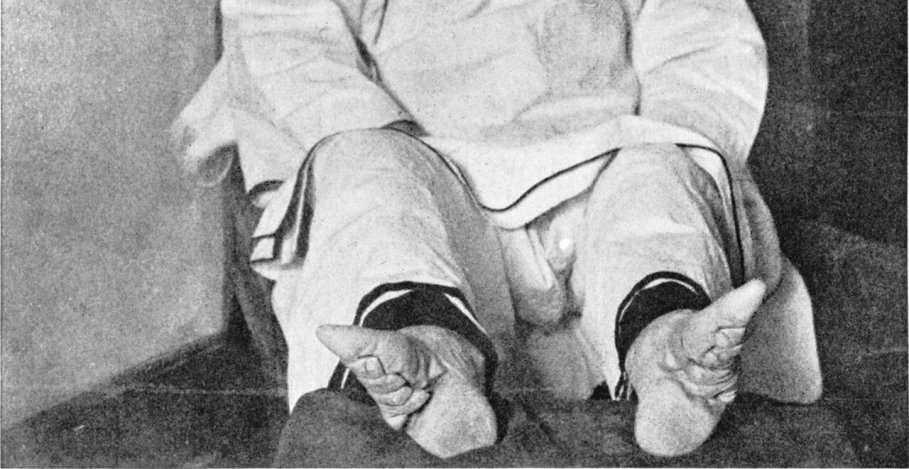
In this article, we discuss the unacceptable atrocity of foot binding and foot whipping.
Foot Binding
Foot binding was a Chinese custom across all social classes that involved purposely breaking and tightly wrapping the feet of young girls as from about four to eight years old until adulthood in order to change both their shape and size.
The aim of the practice was to create very small feet (about maximum ten cm long) for reasons of marriageability, to demonstrate status and wealth (the family didn’t need the girl to do heavy agricultural work), erotic appeal, and as a rite of passage that showed the girl’s discipline, obedience, and submission to her husband and family.
It’s perhaps needless to say, but foot binding had lifelong consequences for the woman involved, including deformity, infections, severe pain, and permanent mobility issues.
Fortunately, the practice was entirely eradicated in the mid-20th century.
Foot Whipping
Foot whipping, also known as sole caning, foot caning, bastinado, or falaka (or falanga), is a corporal punishment administered to the soles of the bare feet.
It involves restraining a person’s legs so that the soles of the feet are exposed, followed by repeatedly striking on the soles with a cane, rod, leather strap, or whip.
 eBook

Historically, it was a practice carried out across Europe and Asia. In fact, certain regimes, schools, and judiciaries used this method because the soles of the feet have a multitude of sensitive nerve endings, which makes this punishment extremely painful.
Additionally, unlike flogging, for instance, striking the soles of the feet minimizes the risk of damaging internal organs or causing disastrous open wounds.
Hence, this allows the punisher to maximize the pain inflicted, without seriously damaging the one being punished. Nonetheless, foot whipping can still result in severe issues, notably internal bleeding, nerve damage, tissue tearing, hyperpigmentation, and long-term difficulty with walking.
Foot whipping might seem outdated, but, unfortunately, it’s still practiced widely as a punishment or torture method in many countries, notably in prisons.