


The way you breathe tells so much about yourself. Not only about your body, but likewise about your mental and emotional state.
Breathing is something extraordinary. It’s both external and internal: it can be watched outwardly and it can be felt inwardly. In addition, it’s an automatic process of your body (essential to inhale much-needed oxygen), but your breathing patterns can also be deliberately manipulated, which forms the rationale for many different types of so-called breathwork.
 eBook | Click for details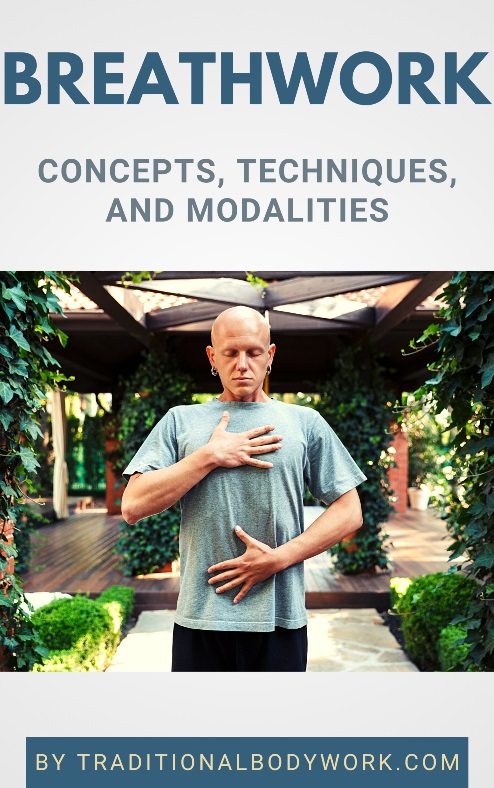
Fast and shallow chest breathing may indicate that you are scared, under stress, hurried, or anxious. If it’s your habitual way of breathing, it may point to a respiratory disorder or other underlying health condition, or perhaps to past emotional distress or trauma, or simply to a habit.
In addition, it can be caused by high altitude, physical exertion, a lack of regular physical exercise, air pollution, smoke, a lung infection, a common cold or flu, certain medications, poor blood circulation, or poor posture, among other things.
Breathing affects your diaphragm, abdominal muscles, psoas muscles, back, chest, ribs, and lungs, and they in turn — together with your posture — affect the way you breathe or can breathe.
Tension in the abdominal area can have negative influences for the diaphragm by obstructing its downward motion on the inhale and subsequently its efficiency in bringing air into your body. Tension in your shoulders and chest can also interfere with a normal, healthy breathing function.
eBook | Click for details
Observe your breathing pattern when you do things. It can tell you in what state your body, emotions, and mind are. An important rule of thumb here is that relaxed breathing relaxes you and makes you do things more calmly.
In my experience, I have learned that controlling my breath helps me perform both physical and mental tasks more calmly and efficiently. When I notice my breathing becoming faster and shallower, I deliberately “take a deep breath” — and it works wonders for me.
Without going deep into the particulars of breathwork, I will explain how I do that. It may be helpful to you.
So, when I notice my breathing becoming rapid and shallow, I immediately switch to slow, deep abdominal breathing — also known as diaphragmatic breathing or belly breathing.
If you don’t know what abdominal breathing is or how to do it, simply look it up online — you’ll easily find many guides and manuals. Deliberate abdominal breathing is not difficult to learn, and once you grasp it, it becomes quite easy. An example guide can be accessed on the Harvard Health Publishing website at Learning diaphragmatic breathing.
eBook | Click for details
Note: many guides on abdominal breathing will emphasize that only the belly rises and not the chest. Please keep in mind that this is not entirely true; the chest does move as you inhale and the lungs expand, but much less than during shallow chest breathing. It’s rather that with abdominal breathing, the belly rises much more noticeably, while the chest moves less.
Now, this is how it works for me: using abdominal breathing, I inhale slowly and deeply through my nose “until the top of my lungs.” When I reached the top of my inhale, I exhale slowly and fully through my mouth until every bit of air is expelled, while “guiding” and “following” the exhale movement into my belly and then deeper into my pelvic floor. I continue until my body naturally signals the need to inhale again — an automatic response to its need for oxygen.
When I reach the maximum exhale and feel the need to inhale, I let go. The inhale then comes automatically, deeply, fully, and abdominally, naturally filling up my lungs to their maximum capacity. Once I have again reached the maximum inhale, I repeat the exhale process I just described.
You’ll find that doing this just two or three times is enough to completely relax your body. As mentioned before, it works wonders in calming me down and helps me doing the task at hand more efficiently, effectively, and pleasantly.