

It seems we’re living in times where everything needs to reinvent itself to serve a rapidly changing world, and massage, bodywork, and fitness practices certainly don’t stay behind. It’s hard to keep up with “new” developments, to be honest.
 eBook
eBook
So, here we have one of the new kids on the block: the so-called bossy massage. Well, actually, the modality is already more then a decade old, but lately gets some more traction, here and there. Let’s take a look at what it entails.
Now, bossy massage is coined by somatic educator and intimacy coach Dr. Betty Martin, who’s also famous for her Wheel of Consent model. Bossy massage is positioned as a therapeutic treatment modality, one in which the person who receives the massage explicitly directs every single action of the massage practitioner. Indeed, that’s something else, isn’t it?
In fact, it’s not even really meant as a “massage,” but as a somatic communication tool in practices like intimacy coaching, couples workshops, and sexological bodywork to help people overcome emotional inhibitions and build confidence in expressing their desires and boundaries.
It’s also important to note that bossy massage is not a specific massage style or technique like Swedish, Thai massage, or deep tissue massage. It’s just (some sort of) massage and touch. It’s rather custom-made by the receiver. That is, if they instruct the practitioner to use Swedish gliding strokes on their body, then it becomes a Swedish massage. If they tell the masseur to squeeze or press their feet, it becomes foot massage or foot reflexology. There you have it!
How Does a Bossy Massage Work?
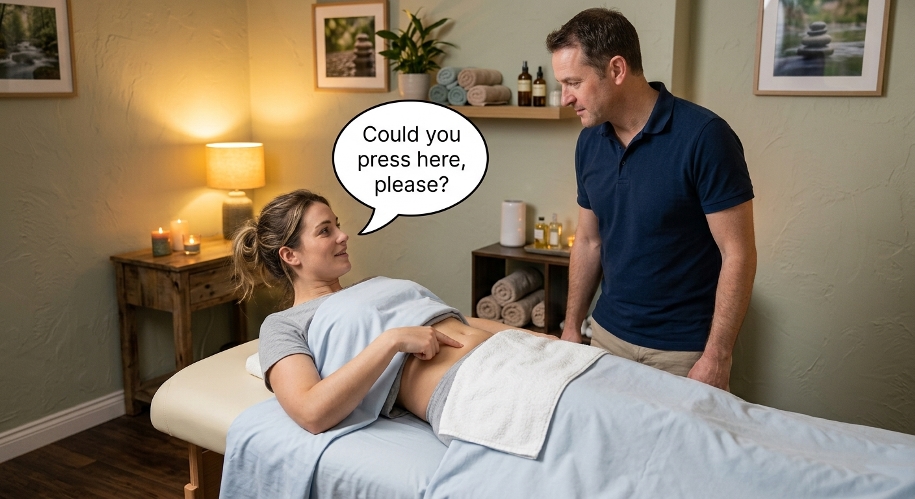
The idea is that the receiver tunes into their body and explicitly instructs the giver exactly how, where, and with what pressure they want to be touched.
Subsequently, the massage practitioner (or intimacy coach, somatic coach, or sexological bodyworker, etc.) carries out that exact action for about five to ten seconds.
The practitioner then steps back and removes their hands, waiting for the receiver to give a new instruction. If the receiver says nothing, the giver continues to wait without touching them.
Keep in mind that all types of touch are possible. For instance, it may include erotic touch, but only if that is the explicit desire, agreement, and boundary set by both participants beforehand. It’s here where Betty’s full mutual consent model (Wheel of Consent) comes into play.
The Supposed Results and Benefits
It’s thought that bossy massage eliminates the expectation that touch must lead somewhere i.e., has a preset goal or should follow a standard full-body routine. The giver has no agenda and operates solely “in service” to the receiver.
eBook
It’s also about overcoming passive compliance. That is, many receivers instinctively stay quiet during massages when the pressure feels “wrong” or uncomfortable, but in bossy massage the receiver is in full control and guides the practitioner.
Bossy massage forces the receiver to step into a leadership role over their own body; without (a bossy) instruction given to the masseur/masseuse — nothing happens.
The practice also promotes emotional self-awareness; it significantly slows down the interaction, and tends to surface deep insights or emotional release. For example, it may show how difficult it can be to ask for what one wants, or how exceptional it feels to have one’s boundaries entirely respected. In fact, it’s almost like a kind of emotional or trauma de-armoring treatment.
In Conclusion
I think it’s a great way for people to “be in control.” That is, to be able to freely express one’s wishes and desires. It can indeed be freeing and serve a therapeutic goal, such as learning to set boundaries or more readily asserting oneself.
eBook
And yeah, on a physical, sensory level, I admit that sometimes, when having a massage, I would want the therapist press or pull here or there, or longer here and there, and so on. So, that’s great.
Nevertheless, bossy massage takes away “the surprise.” I mean, there are so many types of massages and so many types of techniques, movements, poses, and positions. Clients (receivers) typically have limited knowledge of what’s possible in different types of massage therapies and might not know what would feel even better than that what they ask for.
So, there’s also something there of just letting the practitioner decide what to do. To be open, surrender, and to discover and experience what feels good and what not. Afterwards, sure, the bossy massage can do wonders. I suppose it’s a balance that needs to be found.
But, then again, bossy massage is not really a massage, isn’t it? It’s rather an emotional exploration for the receiver.
Anyway, if you want to know more about this “massage,” I think it’s best to just watch Betty Martin’s YouTube video The Bossy Massage. Who else than the inventor can explain best what it is (or supposed to be). Have fun.