

The phrase “barefoot journaling” can actually refer to one of two different practices. But before I talk about those, let me first explain what’s involved in journaling.
Now, “journaling” is the activity of regularly writing down your thoughts, reflections, feelings, and experiences in a personal notebook or digital platform, a kind of diary-keeping.
 eBook | Click for details
The reason to engage in journaling is to have or create a form of self-expression, self-awareness, self-connection, self-discovery, and mental clarity. It’s a private space to process/digest and manage your mental inner world, emotions, and goals, and can be a means for personal growth, stress reduction, and improved well-being.
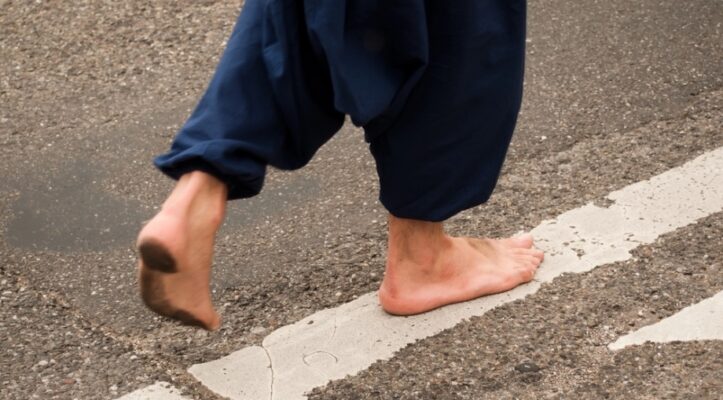
The first meaning of “barefoot journaling” has actually nothing to do with bare feet, but is called so because of a figurative connotation with barefoot walking.
It’s a mindful writing practice focused on unobstructed self-expression, allowing your thoughts and reflections to flow freely, naturally, authentically, honestly, and without pressure, self-editing, or judgment.
That is, you can make grammatical, spelling, or logical errors in your writings; it’s highly informal, and usually happens in short bursts of just a few minutes of writing, noting whatever comes up in the moment. You could call it a “grounded approach” to writing, one that connects to your inner self and to “what-is-and-what-happens.”
Hence, this type of barefoot journaling has a metaphorical resemblance to walking barefoot, which feels natural, connected, and free.
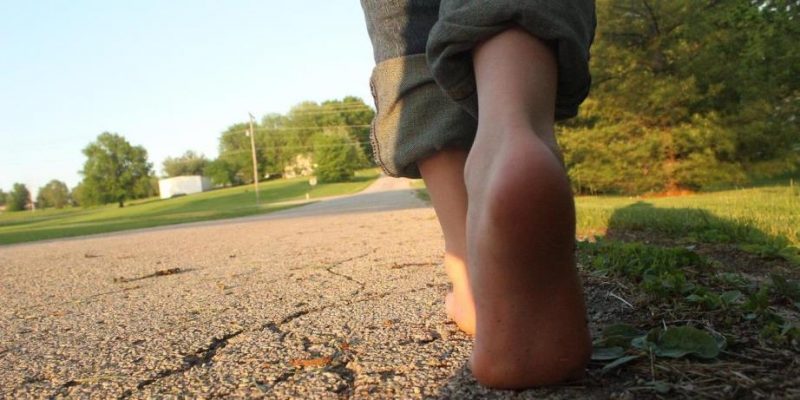
The second meaning of barefoot journaling includes the first meaning, but in addition it also has a literal denotation because it involves physically carrying it out barefoot as a grounding technique.
eBook | Click for details
That is, it’s the act of reflective journaling while sitting or standing barefoot outdoors on natural grounds/earth, such as grass, soil, sand, rocks, moss, or forest floors. It’s part of the earthing practice, which is thought to reduce stress, improve mood, create embodied self-awareness, and support us in feeling more focused.
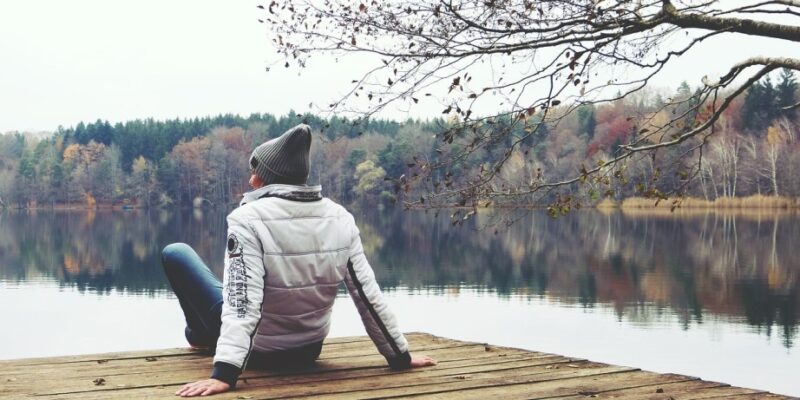
Typically, you would choose a safe, calm, and undisturbed natural environment to do your writing, such as a forest, the mountains, a peaceful garden, a rippling stream, or a quiet park. It’s thought that natural surroundings inspire us to be more authentic and connected to what we write.
Hence, we could call this form of writing “nature-based journaling,” because it’s not only performed surrounded by Nature, but also inspired by our connection to Nature.
It means that we “tune into” and become consciously aware of the feel of the Earth beneath our feet, breathe in the scents of our environment, listen to the sounds, observe the forms and colors around us, and let Nature guide us in our activity.